
Interview with Savvas Shiapanis
Judge & breeder on balance, character, and quality in the American Staffordshire Terrier.
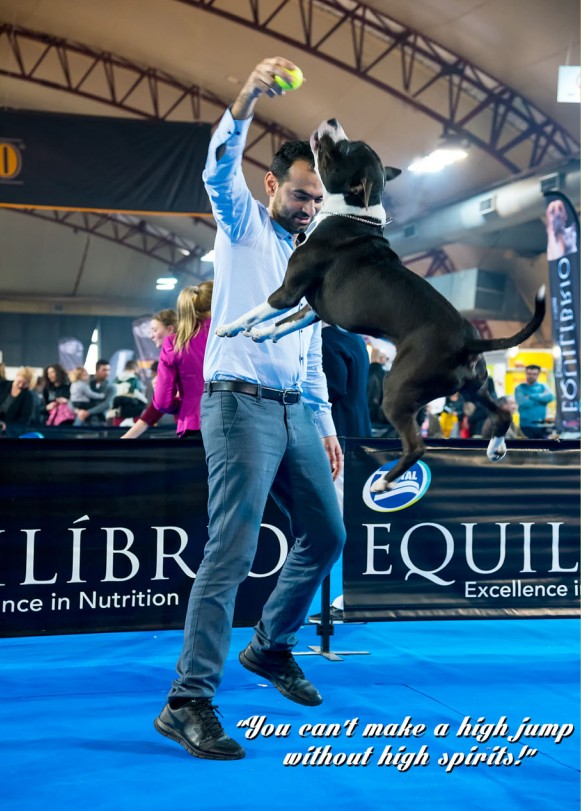
For this edition of the club magazine, we spoke with Savvas Shiapanis, breeder and judge from Cyprus. We sincerely thank Mr. Shiapanis for his detailed and open answers. With this interview, we hope our members get to know him better as a person, breeder, and judge for the upcoming championship club match.
Savvas Shiapanis is an active dog man from Cyprus, where he is not only a member of the Cyprus Kennel Club, but also the first president of the American Staffordshire Terrier Club in Cyprus, a position he still holds today. Over the years, he has developed into a passionate breed enthusiast with a clear vision on health, type, character, and responsible breeding.
1. As our club members know, you are judging our upcoming specialty. Could you please introduce yourself?
Hello Amstaff People.
First of all, I would like to thank the American Staffordshire Terrier Club Holland for the honor and the trust for the invitation to judge at its National Specialty Show. I am sure it will be a great day that we can all enjoy our sport and spend time with this lovable breed.
I was born and live in Cyprus, a small island in the Mediterranean Sea that you really should visit. You will love it. I am an active member of the Cyprus Kennel Club and the first President of the American Staffordshire Terrier Club in Cyprus, a position that I still hold today. I grew up in a dog-loving family and throughout my life I have always enjoyed the company and friendship of many dogs of different breeds. I had my first Labrador before I could even walk, and after that the family continued growing with Boxers and Great Danes.
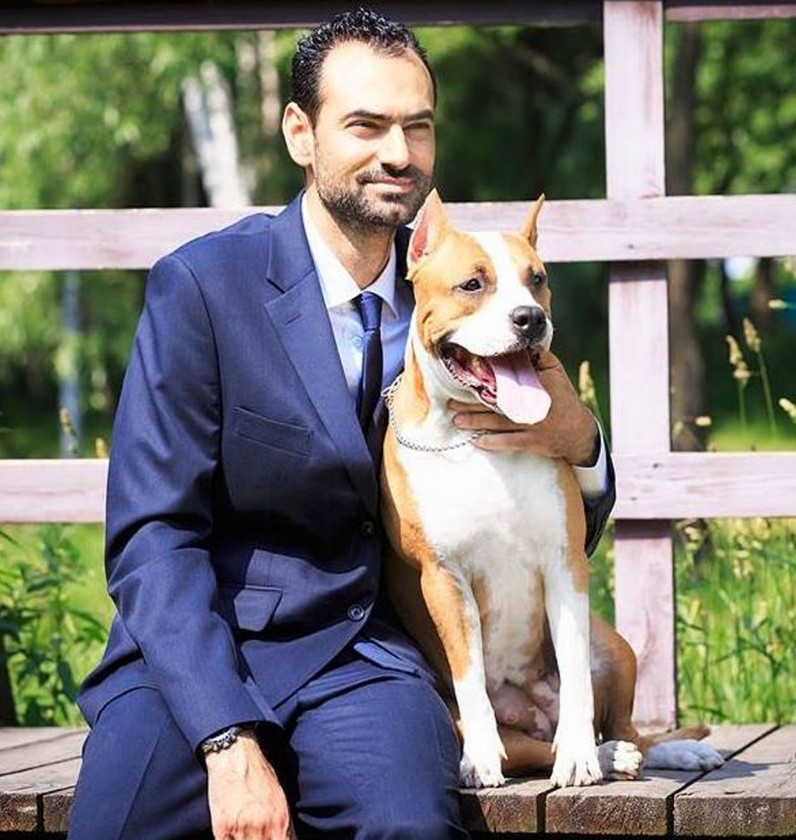
After some years, things became a little more serious and I had the chance to get an Amstaff that changed my life completely in many ways.
In my breeding, I try to keep as much healthy quality as possible, with health and breed standard as my top priorities. I think this effort has been rewarded, as my dogs have been successful at numerous dog shows, with excellent results in Cyprus, abroad, and at World Dog Shows.
I work as Head of the IT department at the Cyprus Union of Bank Employees. Yes, I am a real computer geek. Because I have always been a very active person, I always wanted to keep myself busy with many activities. My hobbies and passions, besides dogs, included karate, although I am getting a bit too old for that now. Music is also one of my hobbies, as I used to be a drummer in a rock band for many years. I also love motorbikes and was the first General Secretary of the BMW Motorcycle Club here in Cyprus.
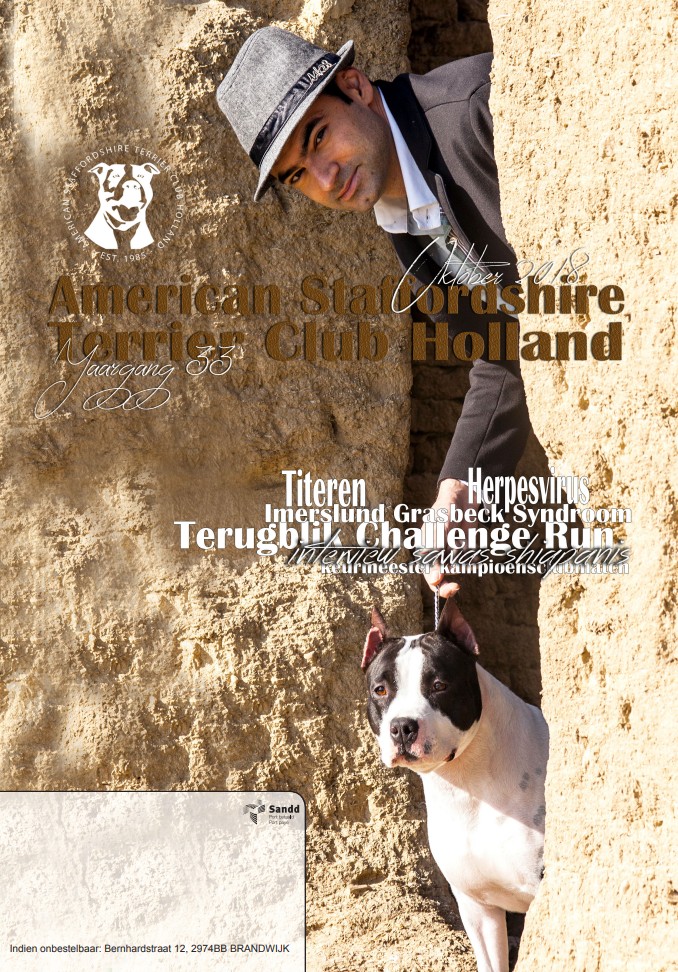
2. On the front cover we see one of your dogs. Why did you choose this particular dog and picture?
Well, when you asked me to choose a picture for the cover, it was really hard to make that choice. It was like asking a father which child is his favorite. I know that sounds unreal, but I love all my dogs in the same way, even dogs that do not live with me anymore. The picture I chose is one of my females, Moloko Shining Field. She is my foundation bitch and the female on which the logo of my kennel was based.
3. How long have you been familiar with the breed?
In Cyprus, the Amstaff was not a very popular breed some years ago. Most people who wanted an Amstaff look-a-like dog, including myself, found it easier to get a Pit Bull. But I had always admired this breed for its loyalty and passion. At some point in my life, I realized that I wanted a dog like that, so when my last Great Dane passed away, I bought my first Amstaff eight years ago.
My way of doing things in life is that whatever I do, I give one hundred percent of myself and try to achieve the best possible result. A bit of my demanding character, a bit of luck with the dogs I chose when I started with the breed, and very strict breeding plans helped me produce quality dogs from my own breeding that I am really proud of. It was not easy and I had to make many sacrifices all these years, but now I can truly feel proud of the result.
Breeding leaves no place for compromises. That is what I have learned in recent years, and of course I am still learning. I have bought dogs that I never used in my breeding program, because I do not believe that every dog must be bred.
4. Which breeds do you like besides the Amstaff and why?
As I mentioned before, I grew up in a dog-loving family, so I lived with many different breeds like Labradors, Boxers, and Great Danes. In general, I admire dogs with strong character and high drive, such as Rottweilers and Dobermans. But in recent years, my passion for the Amstaff has simply grown much stronger than for any other breed.
5. What do you think is the most important thing in an Amstaff?
As many books about our breed describe, and as many people involved with the Amstaff also say, when you first see an American Staffordshire Terrier, it may give the impression of an aggressive and dangerous dog. That first impression can influence the first few minutes of contact. But one look into the eyes of these dogs is often enough to change your mind and make you fall in love with them.
After all, if we read the official description of our breed, the first lines say that the American Staffordshire Terrier should give the impression of a dog with great strength for its size, compact and muscular, yet agile and graceful, keenly intelligent and lively, with a strong affection for its owners.
Few dogs have been more carefully bred throughout their history, and there are few breeds with such voluminous pedigree records. Today, the Staffordshire has emerged from its gladiatorial background as one of the finest of all dogs. He is proud and noble in bearing, combining power with grace and agility. He is bright and alert, and his courage is not surpassed by any other animal. He is intelligent, highly amenable to training and discipline, and adaptable to almost any condition. He is superbly gentle with children, intensely loyal and affectionate, and a wonderful watchdog. There are few dogs that draw so much admiration.
In no other breed is there such a remarkable combination of gentleness, camaraderie, and reliability.
For me, what truly distinguishes the American Staffordshire Terrier is its temperament, its good behavior with children, and its devotion to its owners. BALANCE is the magic word for an Amstaff. A correct Amstaff must have the correct TEMPERAMENT and CHARACTER that the breed demands.
6. There are many different types and lines in the breed. Which types, lines, or characteristics do you prefer?
As we know, our breed came out of many mixes. Even now, many years later, we still have problems in the breed such as broken tails or short bulldog tails coming from the Bulldog that was used in the development of the breed. Back in the nineteenth century, when the breed began to develop and was introduced in America, dogs of our breed were also presented under names like Pit Dog and Pit Bull Terrier.
Even our standard remained rather open while the breed was stabilizing, which is why we still see the Terrier type, the Moderate type, and the Bully type. Even the size in the standard allows variation, with the phrase “Height and weight should be in proportion.” A height of about 18 to 19 inches at the shoulder for males and 17 to 18 inches for females is considered preferable.
So even from this, we can understand how open the breed standard is. I prefer a more moderate and elegant type of dog. I can accept bigger dogs if they have balance, but I do not like very heavy bully-type dogs or excessively huge dogs.
7. Did you notice changes in the breed over the years, positive or negative? And what do you think about the overall quality?
Unfortunately, in recent years we have noticed that many dogs have become bigger in size and much heavier, and quality has suffered because of that. Many dogs also have too short a muzzle and too much skin. In addition, the upper arm has become even shorter, and many dogs lack proper front angulation. Pasterns have become weaker and more sloping, and dogs have become softer and structurally weaker. In many dogs, you can also see that the shoulder is loose and dropping down in front.
Movement problems are also more common now. Rear movement is often no longer parallel, and many dogs do not cover ground properly. Teeth problems are also more common than before.
I think the overall quality of the Amstaff is going down, and that is something that should concern us all as Amstaff lovers, breeders, and of course judges. We must pay attention to these issues and to the health of the dogs.
8. You are both a breeder and a judge of Amstaffs. Can that sometimes be difficult? Does being in contact with breeders and owners affect your judging?
As you mentioned, I am still a breeder and also an exhibitor. I may not be a very good handler, but at least I try my best.
When I am judging, I follow one clear rule: I treat and respect exhibitors the way I would expect other judges to treat and respect me. I judge more than 500 to 600 Amstaffs per year. I judge at World Dog Shows, European Dog Shows, and at international and national shows. I also judge more than ten different breeds. But judging is judging, and friendship is friendship.
A true friend will remain a true friend after my judging, whether they win or lose. If someone no longer wants to be my friend because I did not favor him or her, then that was never a true friend in the first place. If it is a popular breeder or a good friend, and the dog is not good enough, it will not win just because of the kennel name. It is like football: while everyone cheers for eleven people, I judge dogs, not people. I want to be fair and give everyone the same chance under my judging. People should feel sure that they will receive honest judging under me.
9. You sometimes show your own dogs as well. What could be better at shows, and what do you like to see in a judge?
As I said before, I think the most important thing for an exhibitor in the ring is to feel that the judge respects them and will give them a fair judgment. Exhibitors spend time and money to go into the ring. They deserve that respect.
I also like judges who take some time to explain basic things about the dogs to exhibitors, helping them understand their dogs’ faults and strengths, and making their decisions clear.
10. What do you think about sportsmanship in our breed?
In our breed, we may have some of the craziest exhibitors. To be honest, I never had any problems in my own ring, but I have been present in situations where there were problems. I think that if people saw dog shows more as a hobby and a sport, they would enjoy them much more and the atmosphere would improve as well.
At least that is what I try to explain to my friends and to the owners of my dogs. A dog show is only ten minutes of a dog’s life each month. All the other hours and days, our dogs are at home with us. So the show is just one of the activities we can do with our dogs.
11. What do you expect from our specialty?
Going to a new country to judge a specialty is always a pleasant surprise. I have judged in many countries and at many specialties all over the world. I have seen some very nice dogs and some average dogs. For me, the most important thing is that I manage to help exhibitors understand certain things and that everyone has a good day with their dogs at the show.
After all, we all love the same thing: the AMSTAFF.