

Interview with Jeroen Stallen – From the Southern Stables
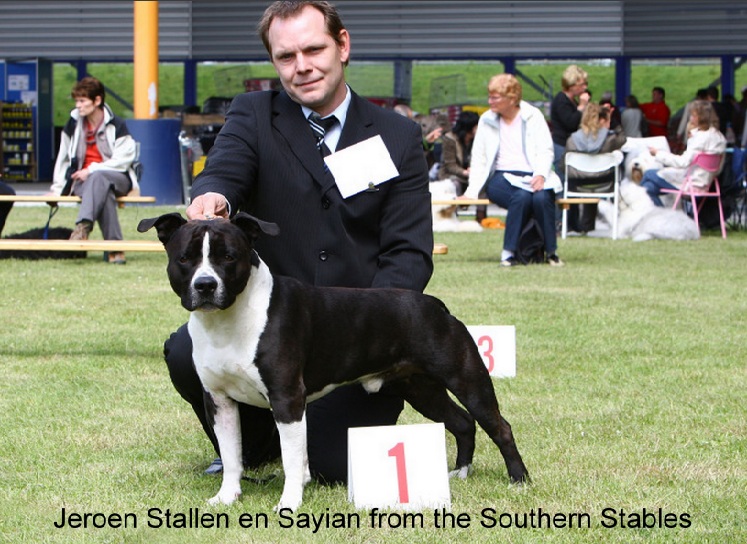
It is Thursday evening and together with a friend I am on my way to interview Jeroen Stallen of the ‘From the Southern Stables’ kennel. Once we arrive, we receive a warm welcome and over a cup of coffee and some treats we quickly end up in a deep conversation about all kinds of things. After a while, I decide to begin the interview.
Fourteen years with the American Staffordshire Terrier is a long time. Could you tell us how it all started?
My interest in the American Staffordshire Terrier started in 1994, and in 1998 I bought my first American Staffordshire Terrier from Erik de Cruif: Blue Claud van de Naked Truth.
What made you choose the American Staffordshire Terrier?
I had owned a Dobermann, but I wanted a different breed because no Dobermann could ever surpass my last one. I was looking for an all-round dog I could use in my lessons and with which I could train, walk, cycle and do other activities. That is how I ended up with the American Staffordshire Terrier.

Which line did you choose?
I was doubting between the Woods line and the White Rock line. What attracted me to the Woods line was their somewhat calmer character and heavier type, while the White Rock/Chasqui dogs appealed to me because they were more active and athletic. By chance I saw Claud’s litter in the club magazine and bought him. That is when the virus started. Half a year later I bought Chasqui Indian Pepita.
How I got her is a story in itself. Years earlier I had seen Frans Diaz at a show with Blue Ch. Skram’s Chasqui Mountain Lion, and at that moment I thought: that is the kind of dog I would love to have. Years later I contacted him for a puppy and he referred me to Mr. Meijer. Some time later I visited him to look at puppies, but there was nothing there for me. Pepita, however, was walking around there and caught my attention immediately. She had the same expression in her eyes as my deceased Dobermann.
After that I called Frans and asked if he had, or expected, another type like Pepita, and that I would be interested at any time. At that moment he had nothing for me, but two weeks later he called me to say that Pepita had to leave Mr. Meijer’s place and asked whether I was still interested.
Of course I picked up Pepita immediately. I started showing her and later breeding with her, with very good results. She became Dutch Champion and three of her daughters also later became champions.

Why did you continue with Pepita and not with Claud?
I liked Pepita’s line better. Claud was a fantastic dog, but his health was not always ideal. The enthusiasm and healthy constitution of Pepita and most White Rock/Chasqui dogs appealed to me more.
What has changed the most in our breed during the fourteen years you have been active in it?
In terms of character, the dogs have become softer, more fearful and more insecure. In appearance they have become coarser and larger. Sometimes people just breed without really knowing what they are breeding with or how to breed. Linebreeding is also practiced far less than before. One advantage is that nowadays people pay more attention to health and do more testing, and I only encourage that, because then you know what you are breeding with.
The first breeder from whom I would have bought an American Staffordshire Terrier, John van Hooff, once asked me if I was capable of handling one. After I answered yes, he showed me a video in which two Pit Bulls/Amstaffs were seriously fighting each other. Then he asked if I still thought I could handle these dogs. I still said yes, though I was deeply impressed. Looking back, I thought this was very wise, because how often do you not hear or read: “Help, my dog is fighting with other dogs and I had no idea it would be like this.” Many people do not even know what they have on the leash, and I think that is a pity.
I never bought a dog from him because the litter I wanted a puppy from, a combination with Willynwood Superman, was already gone, and in the next litter the bitch developed a uterine infection. He did, however, have an impressive stud dog that made a big impression on me: Gwendians Desperado Troy.
Nowadays many people and breeders believe that an American Staffordshire Terrier should be social with other dogs. But that is often misunderstood. Our breed is naturally a confident breed, not one that lashes out or starts fights at the slightest thing. Our breed should be ready when challenged, but that is different from actively seeking a fight.
I often hear people say when their dog reacts, “Well, it’s an Amstaff, right?” But that is not correct. He may be alert toward other dogs, but he should not bark or growl like crazy. Only when he is truly challenged or grabbed should he respond. And then you as the owner decide how far your dog is allowed to go. That is what makes your dog a stable, confident dog with great Amstaff character.

A lot has changed over the years, including breeding. In the past, people practiced a lot of linebreeding and were truly passionate about it. Not anymore. There is much more variation now, which means a lot of type has been lost, and I find that a great shame. When I started, you had to drive or fly everywhere to look at dogs from other breeders. I visited shows and breeders at home all over the place: Italy, Spain, Germany, America and more. Now some breeders simply choose through a photo on the internet. That makes no sense to me, but it is the reality. Many breeders do not have their own vision or opinion, and that comes at the expense of our breed.
Why did you start breeding?
Haha, I honestly do not remember. I always had breeding ambitions, and once I got Pepita, I started. I bred Pepita to CH Truans Nut-Cracker and kept Blue Blade from the Southern Stables from that litter. From the same litter, Gillian went to the Van Eck family of the kennel From Gillian’s Home. Elegance (Hailey) from the Southern Stables went to America, first to Skye Blue Kennels and later to Olmar Kennels.
Which combination did you personally consider the best that you bred, and why?
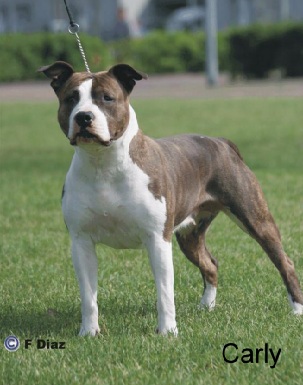
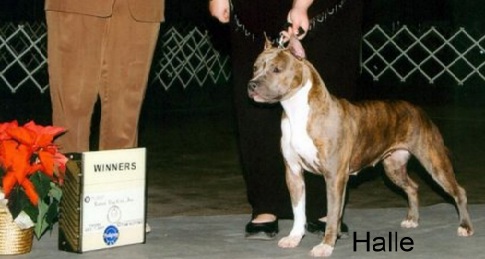
I do not really know, but personally I think the best litter was CH Chasqui Indian Pepita x CH White Rock Chakras Tiger. From that combination came, among others, Carly, Stitch and Diva. Carly became Dutch, Belgian, German and Luxembourg Champion, and Diva became Dutch Champion. They all also produced good offspring.
Which qualities do you require in a dog you breed with?
A dog must not be weak in character or fearful; it needs proper temperament. In appearance it must complement what my dog lacks or what can be improved. And of course I pay attention to health. I test for HD, ED, Ataxia and heart.
Why do you test the heart? Do American Staffordshire Terriers have heart problems?
Not exactly in that sense. I have not had problems with it myself, but I do hear that it appears more often in other lines, and I want to exclude that for my offspring. I believe people should simply test, because then you know what you are breeding with. The Americans were much further ahead with that than we were here in the Netherlands.
Even now there are breeders here who refuse to test because they do not see the importance of it. Back in 2002, Maria van Haren, Olaf Verhorevoort and I had already gone to a seminar in America about Ataxia. Wes White was there at the time to show one of his dogs that had Ataxia. Before testing was possible, in America they were already thoroughly studying pedigrees to find out where and in which dogs it occurred. Of course that could never be determined with 100% certainty, and luckily now we have the test.
And with which faults would you absolutely never breed?
Poor topline, dental problems, serious health issues and unreliable dogs. Those are not things you can easily breed back out.
Which points need more attention in relation to the breed?
Character, health and topline.
Which dog from your kennel are you most proud of and personally consider the best?
Simply Pepita. I did not breed her myself, but I am still most proud of her. I think her character and appearance were simply fantastic. She never had any health problems. From the litters I bred there are several dogs with very good qualities, but there is not one that really stands out above the rest for me.
Which dog from your kennel achieved the most titles in show or obedience?
That would be Carly from the Southern Stables. She became champion several times, and champions also came from her offspring.
And outside your own kennel, which dogs earned your appreciation?
Herring’s Beau Jangles, Ch White Rock Chaskras El Diego, White Rock Charlie Horse and Skrams White Rock Chasqui, also known as Gringo. I used them in the past, but unfortunately it did not work out.
From whom in the Amstaff world did you learn a lot?
From Frans Diaz, Dick Pascoe, Carla Restivo and Olaf Verhorevoort. My sincere thanks to them again.
What is your view on the future of cynology and the Dutch Kennel Club over the next twenty years? Has it changed positively or negatively?
Sometimes positively and sometimes negatively. It is hard to say, because when are you really doing it right? What is good for one person is not necessarily good for another. I do feel that breeding, including linebreeding, is increasingly being restricted, and personally I think that is a pity.
Which Dutch judge has a good vision of our breed, and why?
Martin van de Weijer, because he is honest and has a good eye for the breed, and Cindy Kerssemeijer, because in my opinion she also has a good understanding of our breed.
What do you do with your dogs? Showing, agility, obedience?
All three. I do obedience and showing, and my wife Melanie does agility.
I have also been a dog trainer since 1993 and for some time now I have had my own dog school, www.jeroenstallen.nl. I also visit people at home to help them with the upbringing and training of their dog.
What do you still enjoy about breeding after all these years?
That you constantly meet new people with different ideas and different visions. You keep learning, because, as I always say, you learn something from everyone.
How do you see the future for your kennel?
That I can continue the results of the past years into the future.
If you could give our members one thing to keep in mind about the breed today, what would it be?
Get away from the internet and go do something with your dog: sports, cycling, long walks in the woods or other activities. We have an all-round dog, so use it as such and not just for the couch or because it looks beautiful. Many behaviour and health problems come from too little exercise and overfeeding. A dog that can release its energy feels much better mentally and physically.
And for future breeders and current breeders: visit kennels at home and abroad. Do not focus only on Dutch kennels and dogs, but learn from others and look at others. Only then will you really know what kind of dog you have, because every dog can look beautiful and sweet in a photo. Unfortunately, sportsmanship between people has also been disappearing in recent years, both at shows and on the internet. People, if all goes well we are all here for one thing, and that is to cherish the Amstaff.
May everyone enjoy their dog very much, and remember: most champions are sitting at home.
I would like to thank the people who have helped me over the years and all puppy owners for taking such good care of my puppies. And last but not least, my wife Melanie.
Houdoe and thanks.