

Interview with Wicked Witch & Poison Ivy
On temperament, health, showing, and a lifelong passion for the American Staffordshire Terrier.
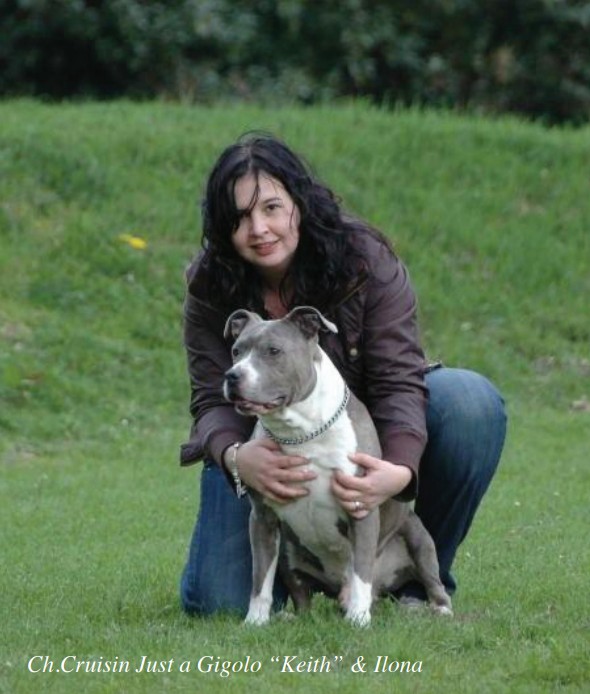
Put six breed fanatics together in the middle of Limburg and you get a hilarious but very enjoyable afternoon. For this interview, Jeroen and I visited Doortje and Ilja Hofman, better known from the Wicked Witch & Poison Ivy kennel. Alongside Doortje and Ilja, Daan, Daniëlle, John, and Francien were also present to talk together about our shared passion: the Amstaff, along with all the sense and nonsense that naturally comes with it.
What followed was an open conversation about the beginning, the dogs, showing, temperament, health, and the many years of experience this family has built up with the breed. Not as people trying to glorify themselves, but as true enthusiasts who have genuinely lived the breed.
The beginning
When we ask how it all started with the Amstaff, Doortje explains that she was looking for a dog. At first, she considered Dogues de Bordeaux, but quickly decided against them. The next breed that came to mind was the English Bulldog. When she mentioned that to her veterinarian, he asked her whether she planned to visit him every single week from then on. That was clearly not what she wanted.
The vet advised her to choose a breed known for strong health and gave her the phone number of a breeder who had puppies at that moment. He also told her the breed in question was the American Staffordshire Terrier. She already knew the breed, because her son Ilja had owned an Amstaff named Meggy.
The number she received belonged to Peter Marks. Through him, they eventually ended up with Frans Diaz, where Doortje bought her first dog, Milly. The contact with Frans Diaz remained, and that is how the Amstaff virus spread through the Hofman family as well.
Ilja adds that in those first years they were really only involved with Frans’s dogs. Because of that, they gained a solid foundation and important experience. Nowadays, he says, it is much less common for people to own dogs for several years before they begin breeding. Very few still work that way. In the past, people first built knowledge and experience with the breed; now many buy dogs specifically in order to breed. According to Ilja, that means some breeders simply do not have the proper foundation to know what they are getting into, and that is unfortunate for the breed.
How many dogs?
When I ask how many dogs Doortje and Ilja have had over the years, a long list of names follows, though they are quite sure a few names are still missing. At that time, Doortje often had Frans’s dogs staying with her. Temporarily perhaps, but they were still there. Ilja’s dogs also came by regularly, and when something came up at a friendly kennel, those dogs too could stay with Doortje without any problem.
At certain moments, that meant there were around sixteen dogs in the house. Ilja says it was never really quiet in those days. Whenever someone came to the door, there was always stress because at least one dog would bark. Once you finally got that one quiet, another would start. By the time everything had calmed down, the visitor was already gone and someone else would often be at the door, so the entire circus started all over again. All in all, it was always busy, lively, and there was always something going on.

Wicked Witch
The name Wicked Witch did not just appear out of nowhere. There is a story behind that as well. Doortje wanted to breed Xena, but by that time she still had no kennel name. She had already submitted five kennel name applications to the Dutch Kennel Club, and all five had been rejected without hesitation.
When Xena turned out to be pregnant, Doortje called the Kennel Club again to ask whether they could help her find a suitable name. The employee explained that she was not allowed to assist with assigning a name and that Doortje would really have to submit another unique application herself.
At that time, Suzan suggested the name Wicked Witch. Doortje immediately liked it, but she wondered whether such a name would actually be allowed. After all, we all know what Wicked Witch means, and whether that would be appreciated by the Kennel Club was uncertain. She called back the woman she had spoken to earlier and said she had finally found a name, though she was unsure whether it could be used. As soon as she mentioned the name and it turned out to still be available, the Wicked Witch kennel became a reality.
Show
In the past, Ilja and Doortje attended almost every show, not only in the Netherlands but across Europe as well. That was not surprising, because they showed frequently and, just as importantly, they often won. Ilja has an impressive list of dogs to his name that he handled successfully. Year after year, he finished dogs as champions without much difficulty, earning points show after show, both with his own dogs and with dogs from friendly kennels.
That may not sound extraordinary today, but at that time there were far fewer Amstaffs than there are now. What was there, however, was generally quality, so winning was certainly not easy. What has not changed is that it was never only about the dog entering the ring, but also very much about the person standing behind it.
It is no secret that Ilja is a man who is direct, does not beat around the bush, and always speaks honestly, whether people like it or not. If you do not want to hear his truth, then simply do not ask him. Not everyone appreciated that kind of directness, and that did occasionally cause tension at shows. If someone tried to tell him he had to leave the ring while he felt it was unjustified, he would certainly let the judges know, and that was not always appreciated.
On the other hand, there is also something admirable about being able to walk into a ring with such confidence that taking first place feels completely natural.
Temperament
As soon as the conversation turns to breeding, one thing becomes immediately clear: according to them, temperament is currently a major issue within the breed. The Amstaff should be an active breed, a dog with power and a dog that stands its ground. At least, that is how it should be. According to Doortje and Ilja, not enough attention is being paid to temperament, socialization is often lacking, and there are too many adult dogs that do not have the character the breed should possess.
Fear, aggression, and insecurity are not traits that should belong in the breed. In their eyes, temperament should come first in breeding. It should be the single most important thing for a breeder when selecting breeding stock.
That naturally raises the question of how it can be that so many dogs nowadays lack correct Amstaff temperament. The MAG test exists to assess dogs, but the question is whether that test is truly sufficient to determine whether a dog is actually suitable for breeding.
Ilja explains that in the early days he once went to a MAG test with Marvin and Marvin’s offspring. Marvin was a sweetheart of a dog and passed all the parts of the test without any hesitation. At the final exercise, Ed came with the doll and even told Ilja, “What an incredibly nice dog Marvin is.” But the moment Ilja approached Marvin with the doll, the dog became so enthusiastic in play that he completely tore the doll apart. Result: Marvin failed. On top of that, Ilja was advised never to breed that male.
When Ilja then asked how the other dogs had done, he was told that they had all passed with flying colors. His reply was that every single one of them was an offspring of that supposedly failed dog. For Ilja, that made it clear that the current behavior test is not complete enough and that temperament is no longer the first priority for many breeders. In his view, that is not a good thing.
Health
According to Ilja, health is an issue within the breed that deserves very serious attention. He believes that as a breeder you must do everything possible to prevent ever having to put down a puppy because of a hereditary defect. Of course, you can never eliminate every risk, but with the tools available today, breeders should make use of them.
In the past, people mainly looked at the dog itself: if the dog seemed fine, then everything must be fine. In this day and age, he believes that approach is no longer acceptable. Especially the Ataxia test has been a real turning point in the welfare of the Amstaff.
Ilja finds it unfortunate that, besides Ataxia, the focus is often mainly on HD and ED, while the exact genetic determination there is not known in the same way. He fully agrees that a breeder must know what they are breeding with, but he is surprised at how easily heart health is overlooked.
As if it is of little importance, while it is scientifically proven that heart abnormalities can be genetically influenced. In his view, heart testing should be the second major test within the breed after Ataxia. It is important, however, that a heart ultrasound is performed together with a Doppler echo. Ilja therefore believes that a heart echo, alongside Ataxia testing, should really be a requirement.
The grip of life
The years have passed, and Doortje and Ilja now see themselves above all as lovers of a breed. We began this interview intending to interview the breeders behind Wicked Witch & Poison Ivy, but that is not how they primarily see themselves. For them, it is first and foremost about love for the breed and the dogs themselves.
When I ask Doortje what she is most proud of, she tells us she is proud of all her dogs, including those she bred herself. Still, one dog left the deepest impression on her: Marvin. In her eyes, he was exactly what an Amstaff should be. They understood each other perfectly and were true companions.
Doortje Hofman currently no longer has dogs of her own. Her health no longer allows it, and she still misses them every day. Fortunately, Ilja still has Keith and Chiquita, so Doortje can still enjoy some cuddles with them from time to time.
When I ask whether there is anything else she would like included in this interview, she gladly takes the opportunity to thank Ilja, Nicky, and Daan for the past years. The care and support they have given her, she says, cannot be put into words. Thank you.
Ilona Peters