

Interview with Randy & Tammy Price of TKO Kennel
American breeders on type, temperament, responsible breeding, and more than thirty years of passion for the American Staffordshire Terrier.

For this edition of the club magazine, we spoke with Randy and Tammy Price, owners of TKO Kennel in Ohio, USA. They have been active in the breed for more than thirty years and during that time have developed a clear vision on type, temperament, health, and responsible breeding.
In this interview, they explain how their kennel name came about, how they became involved with the American Staffordshire Terrier, which dogs formed the foundation of their breeding program, and which principles still guide their kennel today.
Please introduce yourself to our readers.
My name is Tammy Price. My husband Randy and I have had American Staffordshire Terriers for more than thirty years now.
What is your kennel name and how did you come up with it?
Our kennel name is TKO. We came up with that name early in our years with American Staffordshire Terriers. We were at a dog show in Tennessee and had been thinking about kennel names for quite some time. As always, we were spending the afternoon at the dog show with friends when our friend Benny Cheek said, “You love boxing, what about TKO for your kennel name?” And that was the one.
How did you become involved with the Am Staff?
Once again, our story began at a dog show, the way most of these stories do. It was in Lima, Ohio. At that time, we were showing Labradors, which was my first breed. Randy turned to me and said, “If I had my way, I would own that breed,” while pointing to an American Staffordshire Terrier in the ring being shown by none other than handler, breeder, and breed lover Leroy Walters.
I told Randy that in that case we should get one, and that is how the story began. After the show we went to meet Leroy and talk about American Staffordshire Terriers. Our first American Staffordshire Terrier was purchased from Leroy Walters, and he was Ch. Thunderdome’s Mr. Roadhouse.
Was the Am Staff your first breed?
No. As I said, American Staffordshire Terriers were not our first breed. The Labrador was my first breed for almost ten years, and I also had a couple of Dobermans, although those were not show dogs. Randy’s first breed was the Rottweiler. We both still have an affinity for Labradors, Dobermans, and Rottweilers, really for all dogs, but our heart is with the American Staffordshire Terrier.
Do you currently also have other breeds?
Yes, we do have another breed at home. He is a Mini Bull named Dewey.
When did you start breeding Am Staffs?
We had our first litter of American Staffordshire Terriers in 1997.
Where did your original stock come from?
Our foundation bitch and the start of our breeding program was Ch. Tara’s Independence of TKO, from Ch. Tara’s The Untouchable x Roadhouses Sweet as Molasses. One afternoon I was visiting Leroy Walters and his wife and spotted her, at eight weeks old, standing in a run just outside their kitchen window. I caught myself watching her most of the afternoon and asked to see her.
She was the pick puppy from a breeding Leroy had done. I asked if he would sell her, even though I knew full well he likely would not. She was still a puppy and Leroy was not a patient man, so she would need to grow up first. But his wife was a different story. I had to talk long and hard to convince Lucille to let me take her, but I took her home and we were always glad I did. Randy and I adored her, as did all our children. She was a wonderful dog that we still miss to this day.
Most of our original stock came from Roadhouse and Benmar breedings. We always felt that we could not have done better: two great American Staffordshire Terrier breeders, with great dogs, good type, and good temperament. We were very lucky to begin with such incredible dogs.

What was your goal when you started breeding Am Staffs?
When we started breeding, our goal was to breed the best American Staffordshire Terriers possible, following the standard. We felt this was a wonderful breed and wanted to produce dogs that would showcase not only their physical qualities but also their character and temperament.
Do the dogs you have now still go back to that original stock?
The dogs we have in our kennel now are a mix of our original stock and some newer lines.
Describe your kennel facilities.
Our kennel is attached to our home. We have six indoor-outdoor runs, one of which is specifically designated and built for whelping. The kennel is heated and air-conditioned, and it also has a small kitchen. This is ideal because the dogs stay clean and can easily move from the kennel into the house. All of our dogs also spend time inside.
We also have about one and a half acres divided into two separately fenced yards. We have agility equipment on one side so we can train and play while the dogs also get outdoor time. It is important to us not to have too many dogs. An American Staffordshire Terrier requires companionship to thrive and be happy, so we seldom have more than five or six adult dogs, especially now that it is just the two of us.
How many Am Staffs are registered in your country?
We are not sure of the exact number, but I think it is somewhere around two thousand a year.
How many members does the club in your country have?
I am also not sure how many active members our club currently has.
How do you become a member?
To become a member, you need a sponsor from the membership. Randy and I became members of the national club many years ago, and I think Sandy Underwood was our sponsor.
Does the club publish a magazine?
Yes, they do publish a magazine, but I believe it is only once a year now because of the cost of producing it and the time required.
Is there a National Specialty in your country?
Yes, we hold a National every year.
How many litters have you bred?
We are extremely serious about breeding, but we do not breed often. I think about ten litters in our thirty-plus years. Much research is done before we breed a litter. Randy studies pedigrees constantly, we check health records, and we discuss temperament with anyone who may have relevant information about the stud dogs, past litters, parents, brothers, sisters, and progeny.
What do you feed the puppies?
There is no single way to feed puppies. We feed them according to how they develop. Their first feedings always consist of some kind of soaked puppy food mixed with yogurt, ground beef, cottage cheese, and often goat’s milk.
How do you socialize your puppies?
The more a puppy sees and hears, the better off you are. They hear everything here. We have a television and radio in the kennel that are on all the time. Our neighbors are constantly target shooting, so hearing gunfire is normal for them.
They do not go outside before five weeks of age and only after first vaccinations and worming. Then we begin letting them out, first into their own covered private run with equipment, toys, and other things to play with, climb on, or chew. That run is inside the dog yard where they meet all our adults through the fence.
Then each day we take them into a new part of the yard they are unfamiliar with. They learn recall very early and very easily because at that stage they want to stay with you while everything is still new. At seven to eight weeks, they start going into the big yard with the agility equipment and go on short car trips to the vet, the park, Tractor Supply, or Lowes. We keep those trips short and happy, because they are not ready for more yet.
We have four grown children and seven grandchildren, so puppies in our home see a lot of people and are handled many, many times a day from three weeks of age onward.
At what age do you evaluate your puppies for pet or show quality, and what do you look for?
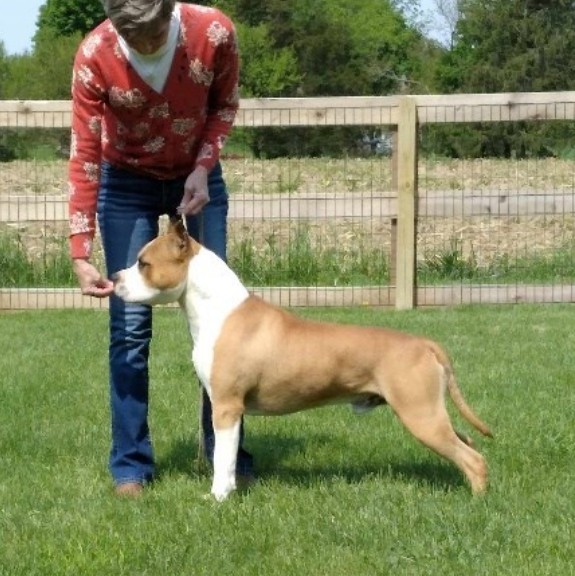
We evaluate puppies from seven and a half to eight and a half weeks. We begin placing puppies at eight weeks, but we often keep them until they are twelve weeks old so that we are sure they are confident and ready for the next phase of their lives. We do not sell puppies specifically as show dogs. We may sell show prospects, but all our puppies are sold as pets and companions first.
Has anyone influenced your breeding program?
Over the years, many individuals have influenced our breeding program. My first mentor in Labradors was Fran Benedict, my mentors in Dobermans were Judy Doniere and Kenny Herrman, and our mentors in American Staffordshire Terriers include Leroy Walters, Greg Roadhouse, Benny Cheek, John McCartney, Kaisa Metteri-Gold, Lydia Castagna, Sandy Underwood, Kim Rudzik, Francis and Greg Connor, and Ed Thomason.
Each of these people taught us something, and I am sure there are many others I have failed to mention. When we started in American Staffordshire Terriers, it was a very different time. We were actually all friends, fighting to preserve our Am Staffs in a United States that was under heavy pressure from breed-specific legislation. We talked to one another, we debated, we listened, and we learned. And after thirty years, we are still learning.
Have you sold puppies to Europe or elsewhere, and do you still have contact with the owners?
Yes, over the years I have sold or placed a few dogs with individuals in Europe.
What kind of guarantees do you give with your puppies?
We guarantee their health and test everything recommended by the Staffordshire Terrier Club of America parent club. We also take temperament seriously. If any issue arises with temperament, we ask for the dog or puppy to be returned to us for proper evaluation.
After evaluation, we discuss the issue with the owner and decide whether a replacement is required or whether the dog can be returned to them. If we are not comfortable, we simply refund the money and keep the dog ourselves until an appropriate place comes along.
Do you attend the USA National Specialty? Is there a big difference between people and dogs in Europe and the USA?
I try to attend the National Specialty every year if possible. I do not think there is a big difference in the quality of dogs in the USA compared with Europe. I have seen exceptional dogs in both places and met extremely talented and educated breeders wherever I have judged.
Are you a judge?
Yes, I am an AKC judge for American Staffordshire Terriers. I love this breed; it is our breed, and I love to judge. I always consider being asked to judge as an honor and a gift. You could not give me a better compliment.
For the health, welfare, and heritage of our American Staffordshire Terriers, it is important that we judge to the standard and not simply fault judge. Too many people can point out every fault, but fail to see the virtues in their own breeding or in that of others. I always consider type and temperament first and foremost.
What about the difference in handling a dog in Europe or in the USA?
Judging here in the States is a bit different from judging outside the USA. Here there are many professional handlers. In Europe, it is more like it was when we first started showing in this country: mostly families showing their own dogs and simply enjoying the day.
Tell us something about temperament.
Let’s talk temperament. If you are reading the standard, it clearly references temperament even without using that exact word. In the general impression, it tells you everything you need to know: this is a keenly alert dog; his courage is proverbial.
The American Staffordshire Terrier is confident, loyal, and unafraid of confrontation. That does not mean the breed is quarrelsome; rather, it means the opposite. A confident dog is stable and calm in demeanor but does not shrink or become timid in the face of chaos and turmoil.
How would you rate type, temperament, and soundness in order of importance?
I cannot rank them. They are all equally important. Without type, they are not an American Staffordshire Terrier. Without sound temperament, they are not an American Staffordshire Terrier. And without physical soundness, it does not matter if the other two are correct. So I would say they are all equally important.
Do you think there are any health problems in the breed?
I feel the American Staffordshire Terrier is a relatively healthy dog, but there are things we must consider that can affect the breed’s quality of life. When considering health issues, I follow all recommended testing specified by our parent club. We have an active health committee, and their recommendations must be taken seriously. They are tasked with making recommendations that affect American Staffordshire Terrier health on an ongoing basis.
What are your thoughts about breeding? Do you prefer inbreeding, linebreeding, or outcrossing?
We have done linebreedings and outcrosses in our breeding program. But we do not do inbreedings. To be honest, that takes expertise beyond my abilities, and really beyond most people’s. That is why I feel it should be avoided except in extreme cases and only by people who are very well educated about the risks involved.
Who is your all-time favourite?
Randy and I share the same all-time favorite: Ch. Benmar’s Ringmaster “Dillie”. We did not breed this dog, but we did co-own him for a short time. In my mind’s eye, he was the ideal American Staffordshire Terrier, and his temperament was impeccable.
Who is your biggest winner?
Our biggest winner of all time was Ch. TKO Golden Boy. We called him Oscar, but he belonged to Max Van Slijpe, who called him “Boy.”

Is the Am Staff standard a good one?
It leaves room for interpretation, but I believe that if you read the standard carefully and understand structure and movement, you can close your eyes and see the ideal American Staffordshire Terrier. The one thing I see everyone doing is trying to make the standard fit their dog, when what we should really be striving for is to make our dogs fit the standard.
How important is grooming?
I think grooming is extremely important, and probably not for the reason you think. Grooming allows you to form a special bond with your dog. I groom the dogs we will be showing daily. I brush, rub, clip, and massage. It is a time of gentleness and affection that they enjoy and look forward to.
What are your interests outside of dogs?
Randy and I have very little interest outside of dogs. Only our family is more important.

What advice would you give to new people entering the breed?
My advice to a new person in the breed is, first and foremost, love your dog. Read the standard daily. Learn and understand structure and movement. Find a mentor, more than one if possible. Every person will give you their own individual perspective. Ask questions, watch, and listen.
Take your time before you breed. Learn about the American Staffordshire Terriers of the past and do not focus only on the fact that they won a lot. Talk structure with American Staffordshire Terrier people, with people from other breeds, judges, and experienced breeders.
Is there anything we did not discuss that you would like to tell our readers?
Remember that the quantity of what you breed is nowhere near as important as the quality of what you are breeding.
Thank you very much for taking the time to do this interview. We truly enjoyed it.
Thank you for the opportunity to share my views. I hope you enjoyed learning about Randy’s and my life with American Staffordshire Terriers. The dog world has been a beautiful gift to us and to our lives. I hope all of you will experience the same.