

Introduction by Wil de Veer
Kurt and Els own the Gentle Power kennel in Belgium. They also ran the Powerbreed Doghotel. For many members this kennel may still be unfamiliar, but this interview will change that. In my opinion it has become a very extensive and interesting interview, which also provides clear insight into the situation in Belgium regarding measures affecting all breeds.
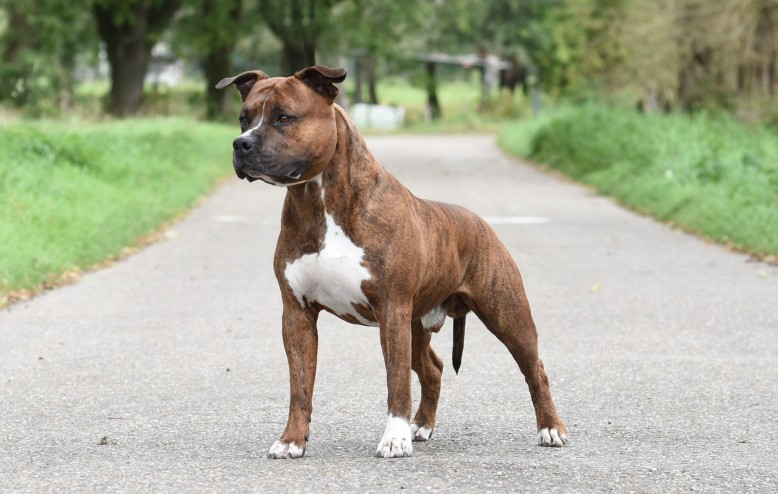
Please introduce yourselves and your family to the members of the ASTCH.
I am a teacher in secondary education (ages 12 to 18) for students with behavioral and character disorders. Els runs the dog hotel. From morning until night she is busy caring for our boarding guests and our own dogs. I help out after work and during holidays. My first Amstaff came in 1995, Els caught the virus in 2006. The Amstaff is what brought us together as a couple, so the breed also became a shared passion for us.
How did the kennel name come about?
In the General Impression of the breed standard there are two words that, to us, are leading for the breed: ‘graceful’ and ‘strength’. Putting both words together did not appeal to us, so we looked for two suitable synonyms, namely Gentle (in the sense of noble) and Power. GentlePower was born.
Where is the kennel located?
We live in Belgian Limburg, close to the Dutch border, more specifically in Neeroeteren, a borough of Maaseik.
Where was your first brood bitch purchased and where the first male?
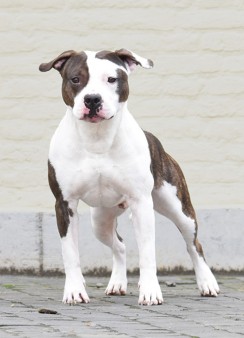
Els took over the bitch ‘Iron Redskins One Million Dollar Baby’ from Stocky Rascals, and I got the male ‘Stocky Rascals Only one Reason’. At that time Els and I were not yet a couple and breeding was far from our minds; we only wanted to show.
Were more brood bitches purchased later?
Yes, Fantazija OD 1300 Kaplara (2016, Serbia) and Legend of Gods Remove Anger (2017, Spain). Last year Hullabaloo’s Just Try To Catch Me (Finland) joined us. She is co-owned with Carmichael’s kennel.
Have any dogs been placed in other homes?
No, co-owning dogs is not very common in Belgium. It seems to me that people in the Netherlands are more open to that.
Do you always keep your own stud dog in the kennel, and if so, can he also be used by other breeders?
At the moment we have two stud dogs in our kennel, ‘Gentle Power Seek And Destroy’ and ‘Carmichael’s Prince Charming’ (co-owned). Both males are available.
Are the dogs kept outside in kennels or in the house?
All of our dogs live with us in the house.
How do you see your breeding program as breeders, in other words what is the final goal?
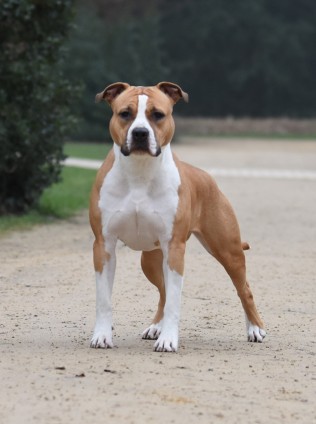
Of course, like every breeder, we want to breed a dog that fully meets the breed standard, but the majority of the puppies go to families. What they mainly want is a healthy and stable Amstaff. That is therefore the most important thing for us.
Do you also use frozen semen? From your own dogs and/or from others as well?
So far we have not used frozen semen. We are currently looking into freezing semen from Ronin and Apollo.
Is there cooperation with other breeders at home or abroad?
We co-own a male and bitches together with Olaf and Monique of Carmichael’s, so cooperation in that area is self-evident.
What do you think of the mutual relationship between Belgian breeders and between Dutch and Belgian breeders? Could that be better?
I think things can always be better. Every breeder has his or her own vision and motivation, which sometimes stands in the way of a fully positive relationship. Of course there may be some competitiveness, as long as it is accompanied by mutual respect.
How many litters have been bred?
I don’t need to explain that a litter of puppies comes with a lot of time and work and that this is not always easy to combine with the dog boarding business. Raising puppies during holiday periods, in the way we like to do it, is not feasible. Still, we try to have one litter a year. Since 2016 we have had seven litters.
How many champions have been bred?
We have one homebred champion, namely Gentle Power Seek And Destroy ‘Ronin’.
Do you also have champions in the kennel that you did not breed yourselves?
Yes, Stocky Rascals Only One Reason (Ace) and Carmichael’s Prince Charming (Apollo).
Which homebred dog are you most proud of?
Our Ronin, although I think Callisto, a male from our latest litter, may perhaps mature just a little better.

How are the puppies socialized?
By spending as much time as possible with them. Our puppies grow up in the living room, which means they quickly become used to household sounds. From four weeks onward, prospective buyers come for puppy visits and we invite friends to stop by. Since we no longer have small children ourselves, our neighbor regularly drops in with her kids. We live quite remotely, so to get the puppies used to traffic and crowds, from the age of five weeks we take them to the market or the fair. Quite an undertaking, but so much fun for us and the puppies. From that age onward they also go together with our adult dogs to the play fields.
At what age do the puppies go to their new owner?
When the puppies stay in Belgium, they leave the nest at 8 weeks. If they move abroad, this happens at the legal age of 15 weeks.
Is there a purchase contract? Does it ever include an obligation to have a particular puppy spayed?
We always work with a purchase contract. Sterilization is not mentioned in it. What is included, however, is that the dog may never be taken to a shelter if the owners, for whatever reason, are no longer able to care for it. The dog is then taken back by us, or if that is not immediately possible, we must at least be given the chance to arrange a solution.
Is there any form of guarantee with the puppies, for example show quality or a guarantee regarding genetic defects?
A guarantee of show quality is never given. After all, you never know how a puppy will develop in the future. A guarantee for genetic defects has been mandatory since January 1, 2025 for pedigree dogs born in Flanders.
What food do the puppies get and what do the adult dogs get? Are supplements added?
We have been feeding Brit to our dogs for 15 years, specifically Brit Care Dog Show Champion. This is a hypoallergenic kibble with salmon and herring as the main ingredients. For the puppies we use Brit Care Grain Free Puppy Salmon. For the young adult dogs, Brit Care is combined with fresh meat from Degomeat to support growth. Depending on the age and individual needs of each dog, we give supplements for coat, joints and support of the immune system.
What is your most memorable success at a dog show and with which dog was that?
Winning Best Baby with Callisto (Gentle Power X-Scape To Reality) and on that same day winning Best In Group with Blizz (Hullabaloo’s Just Try To Catch Me) at the show in Mechelen last year.
Do you show the dogs yourselves or do you use a handler?
We show our dogs ourselves, with the exception of Apollo. Apollo is usually shown by Olaf unless he cannot be there himself.
Do shows and/or judges influence the breed?
Without any doubt! Popular dogs at shows certainly influence the breed. We too may have let ourselves be guided too much by that in our early years. What you see is what you get! That judges play an important role here is beyond question; they must judge honestly and with knowledge of the breed, and especially about that last point I sometimes have my doubts. This is also why we prefer the competitions organized by breed clubs over ordinary dog shows, because the judges are usually breed specialists.
Is there interest in becoming a judge?
There certainly is. Who knows what time will bring.
In what order are the following most important: type, temperament, soundness, balance, color, show quality?
Type, temperament, soundness and balance are, to me, completely interconnected. All four of these qualities make the Amstaff an Amstaff. Color is secondary to me.
Do you see problems in the breed regarding temperament, aggression and/or clearly recurring health issues?
Some time ago I saw a video of your club match from about thirty years ago. The temperament of the Amstaffs back then has, in my opinion, except for a few individuals, been completely lost. Personally I find that very unfortunate, but understandable, because society no longer accepts that temperament. If we were still breeding for the old temperament today, we would not be able to place our Amstaffs anymore. Nowadays dogs, even the Amstaff, must be docile and tame.
In terms of health, I do think we have improved. Thanks to available DNA tests, X-rays and ultrasound scans, we are able to combine more thoughtfully and exclude health problems as much as possible.
Do you have a preference for a certain color, and for a male or a female?
There is no preference for color, although I am less inclined toward blue. However, that has more to do with our experience in the boarding kennel. The number of Amstaffs for which we have to administer medication against allergies is clearly higher in the blue coat color than in the other colors. I myself prefer males, while Els is more drawn to females.
What do you consider the most beautiful Am Staff you have seen in real life in Belgium and which in the Netherlands?
We haven’t been in the show world all that long, and the dogs you see nowadays in the Netherlands and Belgium are unfortunately always the same ones. So I think my answer to this question is self-evident: Carmichael’s Liar Liar Pants On Fire ‘Spot’
Have you visited the National Specialty in the USA?
No, I have not yet had the opportunity, but it is on the planning for this autumn.
Do you also show dogs at exhibitions abroad?
In recent years we have shown our dogs at exhibitions in Belgium, the Netherlands, Germany, France, Switzerland, Austria, Italy, Poland, the Czech Republic and Slovenia.
Do you have any tips for beginning breeders?
Find a mentor who has proven themselves in the breed in the past, a mentor who has sufficient knowledge and is willing to share that knowledge with you down to the smallest detail. Talk to other breeders, visit dog shows, preferably above all the Specialties, visit or take part in the Major or Bully Ganza. Read books and reference works. Certainly do not base yourself too much on what you read and see on the internet.
Should anything in the breed standard be changed?
Certainly not. The breed standard has preserved the Amstaff for nearly 90 years. If the breed standard is changed, we can no longer speak of the American Staffordshire Terrier.
Personally, however, I do feel that the breed standard leaves too much room for individual interpretation. Not long ago I heard the remark: ‘There is only one breed standard!!!’ Of course there is only one breed standard, but then I still ask myself how it is possible that specialist judges disagree and openly discuss, for example, the proportions of the head. If even they do not agree. Just a thought.
Are you members of the Belgian breed club (ASTCB)? Actively involved there?
We are members of the ASTCB. Until recently I served there as chairman.
Are there plans to become members of the ASTCH, or are you already?
We have been members of the ASTCH longer than of the ASTCB.
How does the future of the breed in Belgium look?
Very bleak, not only for the Amstaff but for all pedigree dogs in general.
I do not need to tell you that Belgium is a very complex country with 1 federal and 4 regional governments. A few years ago the Department of Animal Welfare was transferred from the federal level to the regional level. In short, this means that different rules apply to a breeder in Flanders than to a breeder in Brussels, Wallonia or the East Cantons. In May 2024 the breeding decree was approved by the Flemish Government. This decree was to come into effect on January 1, 2025.
What does this Breeding Decree broadly entail?
• The recognized studbook association must have its registered office in the Flemish Region. The problem is that our kennel club (KMSH) has its office in the Brussels Region and may therefore no longer issue pedigrees in Flanders.
• Any association or person can obtain recognition as a studbook association provided they meet a number of conditions. There is therefore a chance that there will be uncontrolled growth of pedigree associations and studbooks.
• At shows in Flanders, every dog with a pedigree issued by a recognized pedigree association must be admitted, including dogs with a non-FCI pedigree.
• The inbreeding coefficient of a mating may no longer exceed 1% in order to obtain a pedigree. So linebreeding can pretty much be forgotten in Flanders.
• If we use a male from abroad, he must comply with the conditions included in the Flemish breeding program of the breed, no longer with the conditions of the country of origin.
• Parent animals born from January 1, 2025 onward must be tested for laxity (PennHIP or Vezzoni). The FCI grading will lapse.
• Parent animals with FCI HD C tested before January 1, 2025 may no longer be used for breeding unless a laxity examination is performed and the results fall within the prescribed margins.
So a major challenge awaits us as breeders in Flanders. Fortunately, just before Christmas we were granted a postponement until July 1.
Do you also have other breeds in the kennel?
No, our hearts lie completely with the American Staffordshire Terrier.
Tell us something about the Gentle Power Dog Hotel.
In 2017 we started a boarding kennel for power breeds. We had room for 10 dogs. However, as of January 1 of this year, we stopped the activity. The increasingly strict regulations concerning dog boarding in Flanders, together with the required investments, make operating a small-scale dog boarding kennel no longer financially viable.
On behalf of myself and our readers, thank you very much for this extensive interview.
Thank you for allowing us to share our story and our views in your club magazine,
Els and Kurt