

Please introduce yourself to our readers.
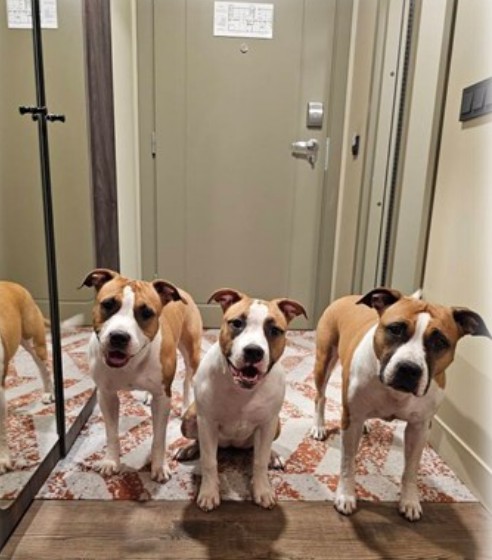
My name is Tiina Jokela, and I live in Nurmijärvi, Finland, with my partner Markus. I’m approaching my 50s and have two adult sons who have already moved out on their own. We share our home with five female American Staffordshire Terriers, all of whom are bred by me.
I’ve been involved in the Am Staff world for nearly 20 years, and I’ve been actively breeding for the past eight. Outside of dogs, I work as a sales representative in the pest control industry. Dogs are a huge part of my life, and breeding has become a true passion over the years.
What is your kennel name and how did you come up with this name?
My kennel name is Hullabaloo's. It holds a special meaning for me, as it was originally used by a family friend who bred Poodles. After she sadly passed away a few years ago, I was honored to carry on the name in memory of her and her legacy in the dog world.
How did you become involved with the Am Staff?
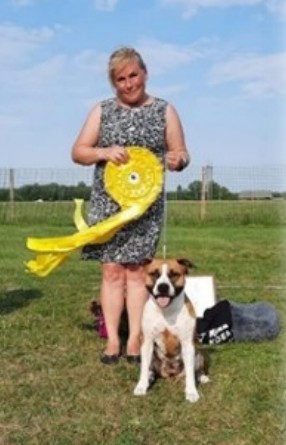
I first became more familiar with the breed through weight pulling, which I was actively involved in. During several competition trips to Sweden, I met Isabell Eliasson, who, together with her former partner Tomas, bred American Staffordshire Terriers under the kennel name Tatonka.
I was truly impressed by the quality of their dogs, and the idea of owning an Am Staff started to grow stronger—especially after I got to know one of their dogs called Shiny, officially known as Carmichael's Clear Diamond Of GA. I told Isabell that if she ever decided to breed Shiny, I would absolutely love to have a puppy from her. That moment marked the beginning of my journey with the breed.
Was the Am Staff your first breed?
No, the American Staffordshire Terrier was not my first breed. Before discovering Am Staffs, I owned a Golden Retriever and a few Whippets. Each of them taught me something valuable, but it was the Am Staff that truly captured my heart and led me deeper into the world of dog sports and breeding.
Do you also have other breeds at the moment?
No, I currently do not breed any other dog breeds, and I don’t expect to do so in the future. My focus is entirely on the American Staffordshire Terrier, which I feel is the perfect breed for me in both temperament and character.
When did you start breeding Am Staffs?
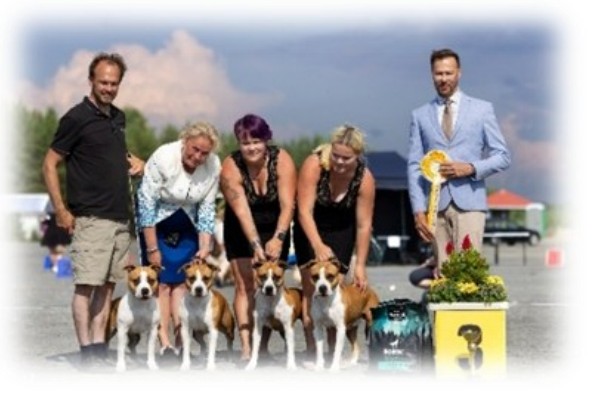
My first American Staffordshire Terrier litter under the Hullabaloo's prefix was born on April 13th, 2017. The dam was Carmichael's Dorien Rose and the sire was Alpine's Rio Grande. The litter consisted of four males and three females.
Where did your original stock come from?
The dam of my first Am Staff litter, Rose, was imported from the Netherlands. The sire, Alpine's Rio Grande, was originally born in the United States but moved to Hungary at a young age. He had produced many offspring, and I decided to plan this litter in collaboration with Olaf Verhorevoort.
What was your goal when you started breeding Am Staffs?
My goal from the beginning was to breed American Staffordshire Terriers that are true to the breed standard—healthy, beautiful in structure, and with that famous terrier drive. I also wanted my puppies to have stable, family-friendly temperaments, making them not only great show or sport dogs but also wonderful companions.
Do the dogs you own at the moment go back to the original stock?
Yes, all my dogs trace back to the original dogs from which my breeding program began. Maintaining those bloodlines is very important to me.

Describe your kennel facilities.
We live in a peaceful countryside home with a large fenced yard where the dogs can safely run and play. Our house has two bedrooms, a spacious living room, and a cozy fireplace room. We don’t have separate kennel buildings—our dogs live with us as full family members and share all the indoor spaces.
How many Am Staffs have been registered in your country?
In 2024, a total of 172 American Staffordshire Terrier puppies were registered in Finland. Over the past few years, the annual number has typically been around 200 puppies. Additionally, approximately 10 imported Am Staffs are registered each year.
How many members has the club in your country?
The American Staffordshire Terrier Club of Finland operates under the Finnish Kennel Club and serves as the official breed club. It has an active and dedicated community of approximately 400 members. The club organizes events, supports breed education, and promotes responsible ownership and breeding of Am Staffs in Finland.
How to become a member?
To become a member of the American Staffordshire Terrier Club of Finland, you typically need to fill out a membership application form and pay the annual membership fee. The process is straightforward and open to anyone interested in the breed. Membership offers access to events, educational resources, and the club’s quarterly magazine. More information is usually available on the club’s official website or by contacting the board directly.

Does the club publish a magazine?
Yes, the American Staffordshire Terrier Club of Finland publishes a member magazine called Amstaffi. It is released four times a year and includes articles, photos, announcements, and breed-related news. The magazine is available both in printed and digital formats, making it accessible to all members regardless of their preference.
Is there a National Specialty in your country?
Yes, Finland hosts a National Specialty for American Staffordshire Terriers every year. The event is organized under the Staffordshire Bull Terrier Club of Finland and is one of the highlights of the year for breed enthusiasts. In recent years, the show has attracted around 100 Am Staffs and approximately 200 Staffordshire Bull Terriers, making it a vibrant and competitive gathering.
How many litters have you bred?
So far, I have bred a total of 10 American Staffordshire Terrier litters under the Hullabaloo's prefix, resulting in 73 puppies. Each litter has been carefully planned with a focus on health, temperament, and breed type.
What do you feed the puppies?
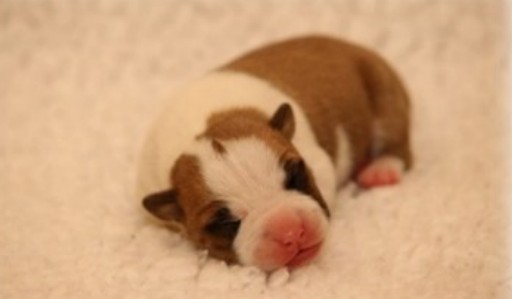
For the first three weeks, our puppies are fed exclusively on their mother's milk. After that, we gradually introduce raw minced meat and fermented milk products like buttermilk. We usually start with minced chicken, and later add minced pork and salmon to their diet.
Around five weeks of age, we begin mixing in softened dry food. In recent litters, we’ve used Naturea brand kibble, which has worked well for our puppies.
We also follow a regular deworming schedule, treating the puppies at 2, 4, and 6 weeks of age to ensure their health and well-being.
How do you socialize your puppies?
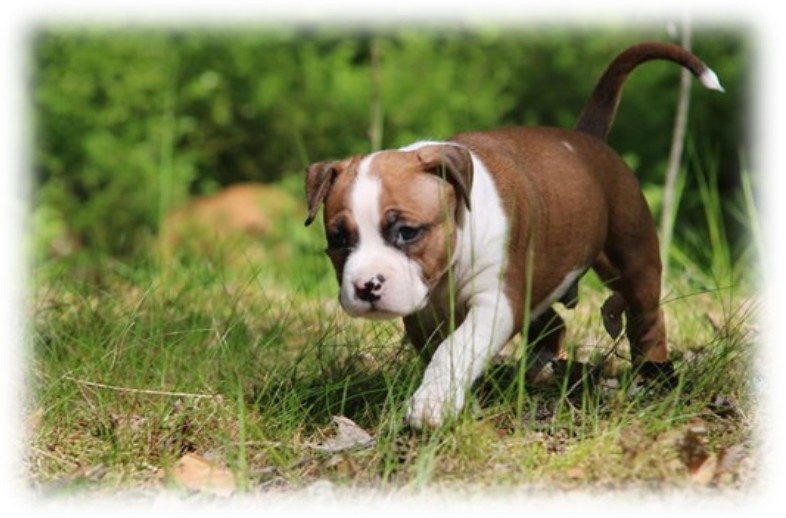
Our puppies are born and raised in a home environment, surrounded by everyday life. Around four weeks of age, we begin allowing visitors to meet the puppies. Before that, we expose them to various household sounds such as radio, television, and other audio stimuli to help them get used to everyday noise.
Our adult dogs are not introduced to the puppies until the dam is comfortable with it, which usually happens around the four-week mark.
When the puppies are 5 to 6 weeks old, we start taking them outside daily to meet people and experience different environments. Weather permitting, they spend time outdoors several times a day, which helps them build confidence and curiosity.
At what age do you evaluate your puppies for pet and show quality and what do you look for?
I usually begin evaluating the puppies around six weeks of age. In a typical litter, I don’t strictly separate pet and show quality. However, if a future home is specifically looking for a show prospect, I do my best to assess the puppy’s structure, posture, and temperament to find the most suitable match.
For me, the most important thing is that each puppy ends up in a loving home where they are treated as a cherished family member.
Has anyone influenced your breeding program?
I’ve been fortunate to have had incredible mentors along the way. Early in my breeding journey, I was inspired by the Swedish kennel Tatonka, and I’m especially grateful to Isabell and Tomas Eliasson, who introduced me to Olaf Verhorevoort of Carmichael's kennel in the Netherlands. Olaf has played a significant role in shaping my breeding philosophy and has supported me as a mentor throughout the years. I’m forever thankful for the opportunity to learn from such experienced and passionate breeders.
Did you sold puppies to other countries in Europe or the USA? Do you still have contact with the owners?
Yes, I have sold and continue to sell puppies internationally. I stay in regular contact with my puppy owners, regardless of where they live. It’s important to me to follow their journey and hear about their lives with the dogs. I truly care about each puppy I’ve bred, and I’m always happy to offer support or simply share in the joy of their everyday moments.
What kind of guarantees do you give with your puppies?
I don’t offer formal guarantees, but I take great care to ensure that each puppy is matched with the right home. I want future owners to understand what they are looking for and make sure the puppy suits their expectations and lifestyle. If a puppy were to develop a hereditary condition, I would discuss the situation with the family and find a fair solution—though thankfully, this has never happened, and I hope it never will.
Each puppy leaves with a registration certificate and a comprehensive puppy package, which includes toys, treats, a bed, food, a collar and leash set, and a one-year membership to the Finnish Amstaff Association.

Have you been to the USA Specialty? Is there a big difference in people and dogs in Europe or the U.S.A.?
I’ve never attended a specialty show in the United States, although it’s definitely something I hope to do in the future. The American shows are incredibly influential and inspiring, and I would love to experience them in person. Unfortunately, my fear of flying has held me back so far, but I’m working on it—and one day, I’ll make that trip!
What about the difference in handling a dog in Europe or the U.S.A.?
I can’t fully assess the differences between American and European handlers, as I’ve only seen them through videos. However, one clear distinction is that in the United States, professional handling is a full-time career for many. There are numerous skilled handlers who make a living showing dogs. In Finland, we don’t have professional handlers in the same way—most dogs are shown by their owners or hobbyists. It’s a different culture, but both approaches have their strengths.
Tell us something about temperament. How would you rate type, temperament, and soundness in order of importance?
For me, health is the absolute priority in breeding. In Finland, dogs used for breeding must have official hip and elbow x-rays, and their eyes must be ECVO-tested. In addition, we perform official heart auscultation and patella checks. I also require ataxia testing and prefer to use clear-to-clear combinations.
I consider skin issues a real concern in the breed, so I never use dogs with skin problems or food allergies in my breeding program. Temperament, structure, and appearance come after health. If a dog is shy or reserved toward people, I won’t use it for breeding—Amstaff must have a true terrier temperament: alert, curious, and brave, with a strong connection to their family. They should be open and friendly with people, though their background means they may not always get along with other dogs.
Show results are secondary to me. A dog with sound structure and good health will live a long, happy life as a beloved family member, which is what matters most.
Do you think there are any health problems in the breed?
Unfortunately, I see a lot of skin problems and allergies in the breed, which I believe are becoming increasingly common. Another concern is the cruciate ligaments in the knees—there seems to be a growing number of cases involving ligament issues. These are areas I pay close attention to in my breeding decisions, and I avoid using dogs with any signs of such problems.
What are your thoughts about breeding. Do you prefer inbreeding, linebreeding or outcrossing?
I aim to avoid tight linebreeding, as maintaining genetic diversity is important for long-term health. However, I do believe that a moderate level of linebreeding can be beneficial when working with well-known and proven producers—always with health as the top priority and with careful consideration of the pedigree. My goal is to strike a balance between preserving valuable traits and ensuring the overall well-being of the dogs.
Who is your all-time favorite?
My all-time favorite is Great Amstaff Good As Diamond “Vega”. She made a deep and lasting impression on me—not only through her qualities as a dog but also through the legacy she left behind. Her daughter, Carmichael's Clear Diamond Of GA, continued that impact in my breeding program. There’s something unforgettable about the way Vega carried herself, and she truly embodied everything I value in the breed: health, temperament, and presence.
Who is your biggest winner?
Among my own bred dogs, the most successful has definitely been Tora – Hullabaloo's Can I Have Your Attention. She has stood out in both performance and presence, and I’m incredibly proud of everything she has achieved.
Is the Am Staff standard a good one?
I think the current breed standard is quite old and could benefit from some updates or clarifications in certain areas. However, overall, I believe it still serves the breed well. It provides a solid foundation for evaluating the American Staffordshire Terrier.
How important is grooming?
Weekly care routines are very important to me. I trim nails once a week and brush my dogs’ teeth at least once a week to maintain good hygiene and health. Before shows, I bathe the dogs the day before and tidy up the tail hair—sometimes I also shave the whiskers for a cleaner look. I also bathe them as needed outside the show season to keep their coat in good condition. In addition to grooming, my dogs are dewormed twice a year and receive vaccinations regularly.
What are your interests outside of dogs?
Dogs and dog shows are my main hobby and take up most of my free time, so there’s little room for other activities. I truly enjoy spending time in the forest with my dogs—it’s a peaceful and grounding part of our routine. I also go aqua jogging at the swimming hall three times a week.
What advice would you give to new persons getting into your breed?
For anyone considering the breed, I strongly recommend getting to know it in person—visit dog shows, breed-specific events, or kennels to meet the dogs and talk to experienced owners and breeders. The American Staffordshire Terrier is a diverse breed with a wide range of temperaments and types, so there’s a lot to see and learn.
It’s also essential to understand that this breed is not typically dog-social and requires firm, consistent leadership from puppyhood to become a well-balanced member of society. With proper guidance and commitment, they can be incredibly loyal and rewarding companions.
Is there anything we did not discuss what you would like to tell our readers?
Thank you for the opportunity to be part of this interview—I'm truly honored. I hope our paths cross someday at shows or other events. Until then, I wish everyone the best in their journey with this wonderful breed!
Kind regards, Tiina Jokela
Kennel Hullabaloo's