
Interview with Bill Peterson – Willynwood Kennel
Temperament Comes First!

Willynwood Kennels is owned and operated by William F. Peterson who is a responsible breeder of American Staffordshire Terriers with over 50 years of experience in the breed. Their focus is on temperament, conformation and structural soundness. They are members of the Staffordshire Terrier Club of America. Since 1960, Willynwood has been striving to produce the ultimate American Staffordshire Terrier, distinguished by a combination of true breed type and ideal temperament. In their over 50 years of breeding American Staffordshire Terriers, they have been fortunate to have produced many champions, including specialty winners. Every breeding they make, is with the intent of producing an even better dog. It is most important however, never to forget that every dog will be someone’s family member so their most important consideration is temperament. They are proud to produce dogs that are easy to live with, easy to train, and “winners” to their families, even if they never go to a dog show.
Mr. Peterson, you started your kennel in 1960, how did it all began?
I have always loved dogs and from a very young age wanted to be a dog breeder. My first breed was the Doberman. I bought a fine quality bitch from a famous and successful German breeder and at her first heat she jumped the fence, ran into the road and was killed by a car. While recovering from this shocking experience and saving my money for another good Dobe, one of my friends showed up with an American (pit) Bull Terrier pup. I was so impressed with it that I got one of its litter-mates and the love affair began.
Back then the UKC didn’t sponsor dog shows and if I wanted to show my dogs I would need to switch to the AKC registered Staffordshire Terrier. (“American” was added to the name in 1971.) My first AKC dogs came from Ike and Jean Stinson’s Crusader Kennels, recommended by my friend and mentor Arthur G. Jones, breeder of some top dogs of the day, including CH. Jones Gay One Roxie. The Stinsons bred and owned some of the best dogs in the breed back then including three Champions from one litter, CH. Knight Bomber, CH. Knight Patroller, and CH. Knight Crusader, multiple winner of the STCA National Specialty Show.

When people visit your website, the first thing they see is: “Temperament comes first”. What do you like to see the most, regarding the temperament of an Amstaff and what attracted you to this breed?
Many characteristics make our breed special, including the obvious great strength for its size, the wide variety of colors, versatility, athletic ability, and above all, the unique temperament, that includes a definite confidence and a sense of humor and of course the most important part of the proper temperament is the inherent love and tolerance of people, especially children.
Without this rock-solid reliable temperament the most beautiful dog is worthless.
What is your all time favorite dog and why?
My all time favorite dog is the one that motivates me to continue as a breeder of American Staffordshire Terriers. That dog is 54 years old and has lived as an image in my mind that I hope to bring into reality some day. I will love that dog, as I have loved every one of my dogs. If the road ends before the destination is reached, I have sincerely enjoyed the journey.

Which improvement did you bring to the breed as compared to the Amstaff from 50,60 years ago?
I would not claim that I have personally brought a specific improvement to the breed, but have done my best to continuously improve the dogs I produce, always keeping my goal foremost; to seek the ideal as described in the Breed Standard. Our breed has always had a wider range of “type” than many other breeds, with the uniformity now than when I started, with the trend now toward the more bully dogs. Care needs to be taken to keep the “Terrier” in the dogs and not let them turn into mastiffs.
What differences do you see between Amstaffs bred in Europe and Amstaffs bred in the US?
When the breed began to be popular in Europe and many new breeders came into it, the percentage of their dogs that conformed to the breed standard was higher than it is now. This was probably due to the need to follow the breed standard as a guide for selecting breeding stock. With the increase of breeders and the number of dogs being shown the same thing happened in Europe that happened in the U.S. Many breeders were influenced more by the dogs that won in the shows, rather than by the specific requirements of the standard, so that now I see little difference in the average quality of either the foreign or U.S. dogs. However, I do believe that there seem to be more truly great examples of the breed in Europe.
You have been breeding for more than 50 years now and you have bred a lot of Champions. There is a lot of Willynwood offspring all over the world. Do you still have any further goals to aim for?
Yes, I do have goals and they are the same as always, to keep trying to produce the perfect example of the breed.

In Holland, Amstaffs and their look-A-likes are often in the news with negative publications about biting incidents on other dogs or people. Some authorities in Holland want to control the breeding and living of these “fighting dogs” (how they call them) with special laws. What do you think about this and how is this regulated in the US?
In the U.S. there has always been an element of public effort to try to control or eliminate a group of dog breeds deemed by some to be dangerous. Over the years, there has been a general recognition that these rules do not work for many reasons, with the difficulty of enforcement heading the list. The trend now is to avoid breed specific legislation and focus on the behavior of the individual and not an entire breed.
Do you have any worries about health or temperament, regarding the breed, in the future? And if so, what are your worries?
Our breed has a history of fewer health and temperament problems than most and that should not change.
With all those years of breeding experience you have, what suggestions do you have for young Amstaff breeders?
The most important advice I can give to a breeders is to learn the breed standard. We have a very good one. It was written back in the 1930’s by a group of experienced and wise breeders and it has never been altered. A responsible breeder must know and understand the breed standard and only breed dogs that conform to it. Unfortunately, a high percentage of what should be the top specimens, dogs that win in the show ring and are popular as breeding stock, deviate from the requirements of the breed standard in many important ways.
How does this happen? Is it because judges are incompetent? Sometimes this is true, however, the breeders and exhibitors bear the responsibility to know what is correct and to present such examples to be considered. If there is no truly standard compliant individual presented it results in a winner that does not conform to the standard. This leads to the unsanctioned mutation of the breed and we have this underway now in several important components of the dog.
Commonly seen are winners who lack the correct topline and with a faulty topline the entire dog is negatively affected because the construction of the entire dog is related to the parts of the structure that comprise the topline; the neck and its juncture with the head and shoulders, the back and its connection to the croup (rump) and the correct set and carriage of the tail. If the topline is wrong the rest of the dog can not be right. The word “topline” is not used in the standard but it is made clear as follows; “back fairly short, slightly sloping from withers to rump with gentle short slope at rump to base of tail” (which should be set low and not carried erect or over back.) No part of the topline should be level. It is a series of slopes, as defined by the standard.
The standard calls for well defined jaws with underjaw strong, lips close and even, no looseness. Too many fail here having weak underjaws, lacking chin and with loose pendulous lips.
Another prevalent fault is incorrect front assemblies with shoulders lacking slope (layback) and short “upper arm” (humerus). This produces a dip in the topline and prevents correct and efficient movement. Common also are rears either over or under-angulated.
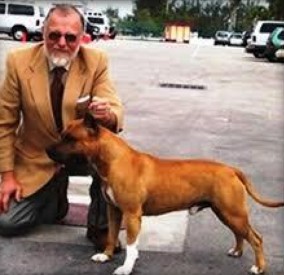
These are a few common deviations from the breed standard. There are many more. The worst is failure to demonstrate the correct happy, friendly, people-loving temperament. That should always come first and be apparent. I have never been fond of the wide-spread use of bait to focus the dog to the extent that many appear frozen, not “keenly alive to his surroundings” as called for in the breed standard. In fact, I rarely used bait in the ring for several reasons, among them I wanted my dog to be shown in a natural way and to demonstrate that he was “keenly alive to his surrounding” and not fixated on a piece of food. Also, I don’t like putting the messy stuff in my pocket or stuffing it in my mouth. Occasionally my dog would demonstrate a happy desire to show “keenly alive” by jumping up and licking the judges face and I would likely then have a “keenly alive” loser. Some happy medium is desired here, the key word is “happy”. Never make excuses for a shy or otherwise incorrect temperament. Temperament is largely hereditary so only use good tempered dogs in your breeding program.
Occasionally, in discussions with other breeders concerning the quality of the dogs, and deviations from the breed standard, they have excused these nonconforming dogs with the statement “This is the type I like.” This attitude is not acceptable. The standard applies to all examples of the breed, whether more bully or more terrier. Being a responsible breeder does not include advocating intentional deviations from the standard.
We want to say many thanks to Mr Bill Peterson for his cooperation and his openness for this interview. We wish him all the best for the future!