

Interview with Jasmijn Beun

Introduction by Wil de Veer
Because there are many possibilities to actively work with an Am Staff, think for example of Flyball and FCI Agility, it seemed to me a great opportunity to give this some extra attention. Jasmijn has earned her reputation in competitions, among others in Agility, and that is why she was asked for this interview. Several times she and her dog Ground Zero Phantasy Dragon were named sport dog of the year.
Please introduce yourself to the members of the ASTCH.
I am Jasmijn Beun. Very early in my childhood I once saw a beautiful, impressive dog and ever since then I have been a great admirer of this wonderful breed. I bought my first own Amstaff when I was seventeen years old, Ground Zero Fifth Av. (Brighton x Khorramshahrs Zenith Baby), born in 2006, call name Andy.
Through him I entered the world of dog sports. When I moved in with my partner, Andy stayed living at home. My husband brought Maxx (Coalminers Elcapone) with him and Maxx reached the age of twelve, unfortunately troubled by many physical complaints. After Maxx passed away I never, ever wanted another dog and a little over three months later I received Ground Zero Phantasy Dragon (Ground Zero Naughty Dragon x Ground Zero Never Say Never), born in 2016, call name Kona, as a gift from her breeder.
With Kona I actually wanted to start in IGP, just like I had with Andy. Kona turned out not to be suitable for that sport at all, but we still wanted to do something and that is when I decided to have a look at an Agility club.
We live in South Limburg, very rural, and in daily life I am an account manager. Virtually all my free time and weekends go to the dogs. For people outside the dog world it is often difficult to understand that so much time goes to the dogs, but the dogs are our lifestyle, our passion and our life’s work.

What was your first American Staffordshire Terrier?
My first own American Staffordshire Terrier was Ground Zero Fifth Av. He was a very serious male who needed a lot of challenge and exercise. Thanks to him I got introduced to dog sports.
I know you do a lot of sports with your dogs. The Dutch Kennel Club facilitates various dog sports. Tell us a bit more about the sport, which disciplines you compete in and what the dog needs to be able to do.
That is correct. The Dutch Kennel Club offers a broad portfolio of sports. Some examples are Dog Dancing, Agility, Obedience and Flyball. Kona and I have been competing in Agility competitions under the Dutch Kennel Club for several years now. These usually consist of two to three rounds per competition and are built around a Standard Course, a course with contact equipment such as a seesaw, dog walk and A-frame, and a jumping course, a course without those contact obstacles. Our preference is for competitions where we can run two standard courses and one jumping course.
To participate, a Dutch Kennel Club license is required. For this, the dog must have a pedigree dog sports logbook, which can be ordered via the website of the Dutch Kennel Club. For imported dogs, the dog must first be transferred to the NHSB. The Kennel Club has a special sports section where all competitions can be found and through this portal you can also apply for your license. Very easy. Entering sports competitions works differently than entering a dog show, because you really need to be ready the moment entries open, as the competition fills up very quickly.
Another important point for participation is that your dog must be properly trained. The dog has to master all obstacles in training, be in good physical condition and you should be able in training to complete a faultless course from jump 1 to 22. Do not expect your dog to do something in competition that it cannot yet do in training. On the other hand, it is unfortunately true that because of a new environment, different equipment, the bustle around the rings and the number of dogs at a competition, they may “forget” certain things. Weave poles are often very difficult for beginner dogs, even if they do that exercise very well at home. Above all, give them time to get used to it, take them to competitions before entering yourself and give them a day of rest afterwards so they can process all the stimuli as well.
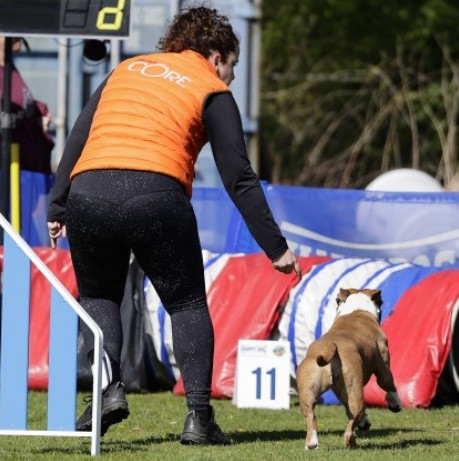
Please explain what happens on a competition day.
My competition day actually starts the evening before the event. I check the catalogue to see when I have to be present, what time we have to start and how much time there is between the runs. Based on that I determine my feeding and drinking schedule. Normally Kona gets at least a handful of kibble, but if she starts late she gets her full morning meal.
I make sure I am there about an hour before the course walk. That gives me time to park, walk Kona and give her something to drink. We usually write our start numbers at home, but sometimes they have to be collected. Then I calmly watch the ring before going to walk the course. Course walking is done in large groups; you usually get between seven and ten minutes to determine your ideal running lines, make your handling choices and identify points in the course where you need to ask extra attention from your dog, or perhaps try something that always goes well in training but you have not yet dared to try in competition.
Some people bring their dogs to the ring well in advance, but I really prefer to have only two or three handlers before me when I arrive at the ring. Kona finds waiting far too sociable and will immediately go look for familiar people she wants to greet. I make sure she is well warmed up, we run some circles to the left and right and we play together a little. I put my jacket or vest beside the ring and then we start. After the course, Kona knows my vest is lying by the exit and that there are tasty treats inside, so that is where she runs straight away. Then I cool her down, put her back in the car, give her her sports drink and then it all starts again from the course walk onward.

With which Am Staffs have you competed?
Only notably with Ground Zero Phantasy Dragon, Kona.
Do you meet more Am Staffs at competitions and are they almost all Border Collies?
At the moment I know of only one other Amstaff that competes, the other Amstaff I knew recently retired last year. Woezel was recently featured in the Raadar. Since most Amstaffs are larger than Kona, they all compete in intermediate and large. Those height classes are dominated by Border Collies and Kelpies, and medium by Shelties.
Up to what age may a dog take part in competitions?
There is no limit to that. The Dutch Kennel Club used to have a veteran class, but that no longer exists. With other organizations you can enter the veteran class from the age of seven.
Are dogs checked for health before a competition?
No. Judges do watch the dogs very carefully and if a dog is not moving well the team will be whistled off. Likewise, if a dog has an ugly fall, the run will also be stopped. At our level, most handlers are very careful with their dogs.
Dogs are also measured when they run their first competition. According to the new rules they are measured again once they reach the age of three. This measuring determines in which class they compete. You may not run a medium course with an intermediate dog and vice versa.
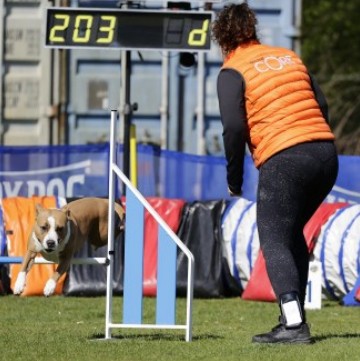
You currently work with a bitch. Is she also allowed to compete when she is in season?
Yes, that is perfectly allowed. There are no special rules for it.
Did you also use other breeds before this?
No, Kona is my first dog with which I practice Agility.
Do you think a male is more suitable than a female?
Oh, difficult to say. I often hear that I make life very hard for myself with terriers, followed by “and then on top of that also a female”. I do not know any different, let us leave it at that.
Do you give the dogs special food and supplements?
Yes, Kona’s basic food is Wellness Core Large Breed. If we have a heavy competition season with lots of training and competitions, I feed Wellness Core Active Life. That just gives a little extra. Kona always looks good, has a beautiful coat, good hard muscle tone, good stool and enough energy. It is a complete food, so I do not need to add vitamins or minerals.
I do give a supplement for muscles, tendons and joints based on collagen, MSM, krill, glucosamine, chondroitin and rosehip. These kinds of sports are a heavy strain on the body and I do everything I can to promote recovery and support the musculoskeletal system as well as possible.
On warm days and competition days I also give a sports drink. For me it is important that she drinks well and because of the nice taste of the shake I know for sure that she gets enough fluids. The drink also contains electrolytes and fats, so she has enough energy again for her next round.
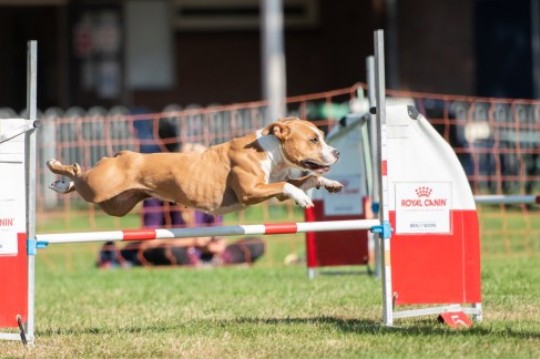
How do you train the dogs to get into optimal condition?
I enjoy walking through the fields around where we live, and in winter Kona occasionally goes on the treadmill. As soon as it is dry our dogs play together outside a lot, and I really notice that this makes a big difference. A very important part of our training is quality rest. Here in the house the other dogs know very well that when queen Kona is sleeping, she is not to be disturbed. I often hear that people focus enormously on condition and muscle training, but skip rest. Rest is actually an important factor for recovery of the body and for processing the stimuli during training.
We also train Agility on Wednesdays and Fridays, for a maximum of fifteen minutes. If things go well, we stop earlier.
Do you also take your dogs to shows?
Yes, but with my other breed, Parson Russell Terriers. I did show Kona in the past and once she retires from Agility she will go again. She still regularly joins ring training and enjoys the attention immensely.
Do you have a kennel name and why this name?
Southern Savages is my kennel name. Southern refers to my roots, I was born and raised in the south and that stays in your blood. Savages refers to my dogs and to me. For some reason I always end up choosing dogs that turn out to be “savage”. They do not let anyone walk all over them and my terrier girls regularly bring home presents in the form of vermin. I myself also do not mince my words and I am never afraid to be the first to do something.
Where is the kennel located?
Voerendaal, South Limburg.
Have you decided to breed?
I made a very conscious decision not to breed American Staffordshire Terriers. I made that choice out of love for the breed, love for my own dog and out of protection for myself and my night’s rest. If someone is looking for an Amstaff, I gladly refer them to the ASTCH and certain breeders.
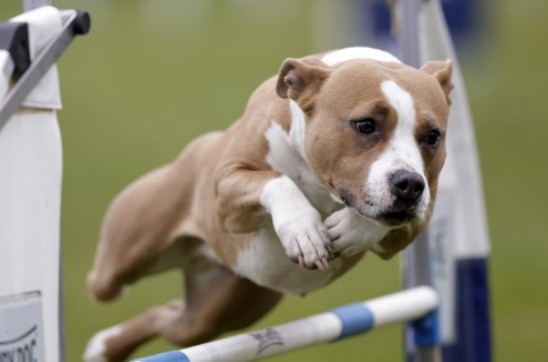
Do you maintain close contact with Dutch and or foreign owners of Am Staffs who are also active in the sport?
No, unfortunately not. The number of Amstaffs seriously involved in the sport is negligible. In the United States more Agility is done with Amstaffs, but AKC Agility cannot be compared to FCI. The level difference is enormous, the equipment is very different and it is a completely different world. Besides that, there is a lot of jealousy and hostility within this breed, while there is room for success for everyone.
How are the relationships between the participants at a competition?
Very good. The atmosphere is always very pleasant and I notice that Kona is well-liked by participants, spectators and judges. When we had to earn our final point last year to move up to grade 3, you could hear a pin drop during our run and when we crossed the finish line the whole hall cheered. I will never forget that moment.
People in the sport know how much blood, sweat and tears it takes to train a dog, let alone an unconventional breed in the sport such as an Amstaff.
Could that be better?
I experience the atmosphere as very pleasant, people are genuinely happy for you when you achieve something with your dog.
What has been your most memorable success so far and with which dog?
For me that was with Kona, earning that very last point to become the first Amstaff in the Netherlands to reach grade 3. Somewhere deep down you are afraid you will not make it. The time limits become tighter and the courses increasingly challenging. I had set myself the goal of qualifying before the Dutch Championship in 2022. Actually quite silly, because I had put a lot of pressure on myself by doing so. Then I would run just outside the time limit, and we are really only talking about tenths of a second. The evening we earned our final point, it was the last round of the evening. Very few dogs were actually getting through the courses and I was completely laser-focused. Kona seemed to know what was at stake and gave everything. When we crossed the finish line and I heard everyone cheering, there were tears of joy. We also finished third in the competition that season and that rosette is framed in my office.
Do you have the ambition to become a judge for both the sport and conformation?
Yes, I do have that ambition, but that is something for the future. I still need to gain a lot of experience in cynology and in the sport.
Do you see problems in the breed regarding temperament, aggression and or clearly recurring health issues?
I read and hear an alarming amount about cruciate ligament problems in Amstaffs. In the past you hardly ever heard about that, now it is everywhere. I also see an alarming number of dogs in poor condition.
As for temperament, my personal preference still goes to the kind of characters we saw in this breed twenty years ago, but I do understand very well that this is no longer desirable in today’s society and that many new owners are not suitable for such a dog either. For me, that fierceness, the terrier in the Amstaff, is a must. I love a dog that asks to be challenged, mentally and physically. They must want to go through fire and ask for more.
In what order do you consider the following most important, or do you think some are not important: type, temperament, soundness, balance, color, show quality?
Soundness, balance and temperament should automatically lead to the right type of dog. For me those first three are extremely important and cannot be separated from one another. Color matters little to me, a good dog has no color. But having said that, I would never buy a fully blue dog myself, that is simply not my taste.
Show quality is of course another thing. I believe that a very good dog can win a lot in the hands of a good handler, but in the hands of a clumsy one it will regularly lose to less good dogs.
There are small faults I can live with, but in principle for both the sport and the show ring you need a well-built dog. A cosmetic fault is naturally of less importance for the sport, but faults in construction are fatal for a sport dog.
Do you prefer a certain color, and a male or a female?
I love females, and in terms of color I really like a deep brindle, but the dogs I end up bringing home are blue fawn with white.
What is the most beautiful Am Staff you have seen in real life in the Netherlands, and which abroad?
My all-time favorite American Staffordshire Terrier remains Wood’s EZ Diamondback Dragon. When it comes to Dutch Amstaffs I could name many beautiful dogs, Skram’s Chasqui Mountain Lion, Parastone’s Major Lazybones and Carmichael’s Liar Liar Pants on Fire, but when it comes to the complete picture I choose my own Kona. To me she is a true Amstaff and gives a perfect interpretation of the general impression described in the breed standard.
Do you have any tips for members who would also like to take up the sport?
Find a good trainer, do not focus on competitions right away but on building a good foundation and enjoying the work with your dog. Start small and do not put too much pressure on yourself and your dog, the rest will follow naturally.
How do you see the future of the breed in our country?
I am sceptical. There is a group of people who are very aware that every choice they make will influence the future of our breed and they do everything they can to keep our breed’s right to exist intact.
With the current developments around cynology in the Netherlands and abroad, certain choices that are made should be carefully considered. Even though we have used the MAG test for years and can also demonstrate its success, we should certainly not feel too safe. Creative ways of dealing with it absolutely do not help us move forward.
How long have you been a member of the breed club and how do you see the future of the breed club? Are you actively involved in the breed club in the Netherlands?
I have combined two questions here. I became a member of the breed club again when Kona came into my life. I spent some time on the events committee and after that I became vice-chair. I see the future of the breed club as very bleak, and that is not because of the few people willing to commit themselves to the breed and the club. Without members, a breed club can do nothing.
If we look at the interest in events in recent years, it is depressing. Many nice events could not go ahead because there were only a handful or even no entries. Attendance at the general members’ meeting is always disappointingly low and for years people have been complaining about “the club”. I keep wondering where all those complainers are.
Do you want change? Do you want to see your breed in the news in a positive way? Do you want to see yourself or your dog featured in the club magazine? Then stop complaining and start doing something. Go to an ASTCH event, submit copy for the club magazine and if you think you can make a positive contribution, contact the board or committee members. I can guarantee that every positive contribution will be welcomed with open arms, just like every entry for an event. Together we are the club.
Is there anything I have not asked that you would still like to mention?
I hope to come across worthy successors to Kona in competition over the coming years. If anyone seriously wants to get into the sport and needs tips at some point, please feel free to contact me.
On behalf of myself and our readers, thank you very much for this interview.
P.S. The photos accompanying this interview were taken by Cees van Hoogdalem.